Attackers take the path your map doesn't cover

Daniel Brodie
Tech Lead, Product Management, Axonius

Itay Friberg
Technical Product Manager, Axonius
This blog is part of Why We Built It, a series on the gaps in exposure management that security pros are still stuck solving by hand, and what we built to close them:
|
Attack path analysis promises to show you what an external attacker can actually reach: which findings sit on a direct line of sight from outside and could be chained into a breach. That promise breaks the moment the map stops at your cloud edge.
Most attack path tools only cover cloud-native networks. Not because on-prem is impossible to map, but because cloud has standardized APIs that make integration easy. On-prem gear is messy, hard to normalize, and vendors skip it.
Anything out of the usual is ignored. Legacy network gear, proprietary firewall rules, the hard-to-integrate equipment that still carries real traffic: all of it sits outside the picture. At the end of the day, it's easy to pretend they don't exist.
A leader asking “can an attacker reach the payments host from the internet?” gets two half-answers (one from the cloud tools, one from the on-prem tools), and the seam between them is exactly where an attacker pivots. The unmapped part of the network makes the path of least friction to compromise.
How to map attack paths across cloud and on-prem
To solve that, we built Attack Path Analysis for any network.
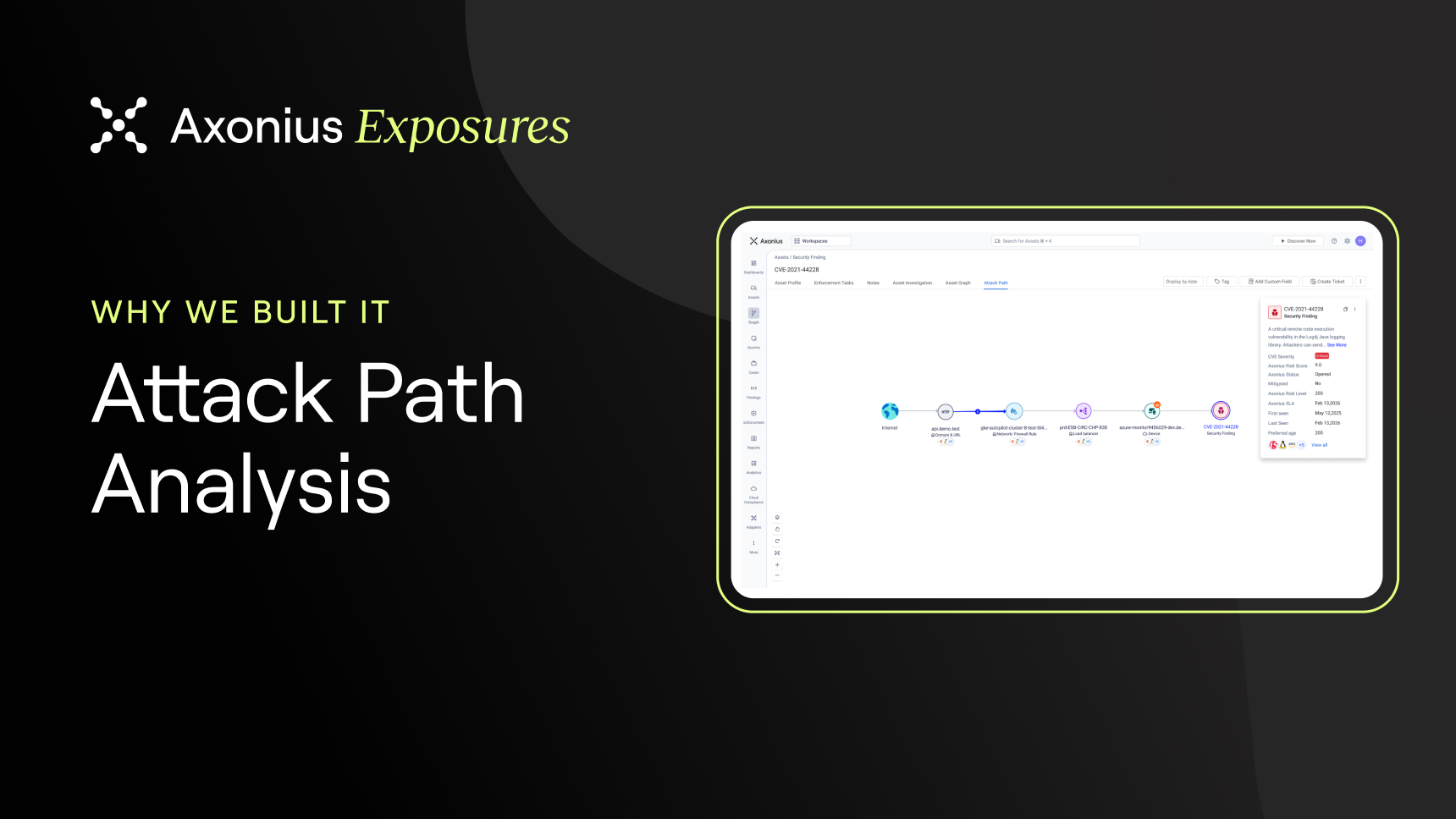
A path is the chain of network systems through which traffic crosses to reach a finding, from an external entry point inward. Axonius reads the network-route data your adapters and network tools already report, joins it to the reconciled asset model, and draws the chain.
The map covers three things:
Network systems wherever they live. Cloud-native services, on-prem infrastructure behind your firewalls, load balancers, distributed networks like Wi-Fi and Cisco Meraki, and the appliances in your data center.
The route between them. When an adapter reports network-route data, Axonius draws the route and links it to the security findings on each hop. No separate mapping project to stand up.
One continuous path across environments. Even when traffic crosses planes, we cover it. A chain that begins at a cloud DNS/load balancer and ends at a host in your data center gets drawn as a single path, because that's how an attacker would walk it.
Why we built Attack Path Analysis
We built Attack Path Analysis to give a consistent answer to one question, regardless of what's in your stack: "can an attacker reach the payments host from the internet?" That means:
The picture you defend from shouldn't be a subset of what an attacker probes. If a tool's integrations end at the cloud edge, the on-prem hop an attacker pivots through never enters the view, and a path you cannot see is a scope you cannot close. The map has to reach the same equipment that the attacker reaches, including the legacy gear that's hard to integrate with.
Cloud and on-prem are part of the path. A path shouldn't break at the boundary between two consoles because many real environments run a mix: DNS at Cloudflare, workloads in AWS, hardware in their own data center. An attacker walks across all of it in one motion. The map has to do the same, drawn as a single path, not two diagrams the analyst stitches together by hand.
Every node on the path carries its context. A topology diagram shouldn't make you go look up the asset context separately. Every node on a path carries the asset and business context Axonius already holds: owner, business unit, what it runs, and which findings sit on it.
Get started with Attack Path Analysis
To get started with Attack Path Analysis, access your Axonius Dashboard, go to Exposures > Security Findings, search for and open a security finding with a network path (filter), and open the attack path view. From there, you can explore the asset and vulnerability details, regardless of the plane and hosting model.
If you're not an Axonius Exposures customer yet, have specific questions, or want to explore Axonius Exposures in depth, book a personalized demo with us.
Categories
- Threats Vulnerabilities

Get Started
See how to make asset intelligence actionable with a guided demo:
- Stop chasing data — work from one asset model your entire team can trust.
- See what's exposed before it's a problem — surface coverage gaps automatically.
- Turn alert noise into action — cut thousands of alerts down, to the ones that matter.